Friday, June 29, 2007

Step up

Creating any wall arrangement can be a quite a project. Adding an angle on top of it makes it even more of a challenge. Better Home and Gardens has some great tips on how to make a knock out photo gallery for your stairway. Taping up paper templates first to confirm your arrangement can save your walls from unnecessary holes.

Tips for Creating a Stairway Photo Gallery:

Think of a place in your house that you and your family pass by several times each day. That is the perfect place for family photos: Everyone in the household will have the opportunity to enjoy the montage as they move through the space.

...Before hanging pictures, consider the lighting. If the stairs are dark, add overhead spotlights on a track. That will not only improve the view, it will make the stairs safer.

A montage like the one shown here allows a lot of flexibility. Pictures from different times, in a variety of sizes, and in various frames can work together because of their family ties. Yet you'll get a more cohesive look by keeping the mat and frame colors in a similar range.

Thursday, June 28, 2007

Blink of an eye

How would you like a camera that could totally eliminate red eye and even better not need any flash at all? Kodak is working on that. They are developing a sensor that will read not only the color but also the brightness of what you are shooting. The new technology will be implemented in cameras they release in 2008.

Kodak's New Sensor May Eliminate Flash: Dory Devlin for Yahoo Tech

Here's how it would work: The new technology would increase light sensitivity of existing image sensors by two to four times. That means a camera's shutter speed could increase, which would reduce camera shake and blurring problems. If it works, it also would allow photographers to shoot in low light without producing grainy, speckled photos.

The proof is in the pixels. In most digital cameras, each sensor pixel detects either the color red, green, or blue and places them into a pattern named for Bryce Bayer, the Kodak engineer who developed it. With the new high-sensitivity technology, half of the pixels will be panchromatic, or clear, so they will capture only the brightness, not color. That means a 12-megapixel camera would have 6 million panchromatic pixels, 3 million green pixels, 1.5 million red pixels, and 1.5 million blue pixels. In comparison, today's 12-megapixel cameras have 6 million green pixels, 3 million red, and 3 million blue.

Monday, June 25, 2007

Streets of New York

If you are located in the Southwest then right now, like me, you are searching for activities to beat the heat and potential boredom of the summers here. Spending a day gazing at photography in the comfortable climate controlled environment in the Phoenix Art Museum fits the bill nicely. In their own words, "Cool art. In a cool place." Since their renovation earlier this year the PAM has been showcasing work on loan from the Center for Creative Photography in Tucson. Their current exhibition entitled On the Street: The New York School of Photographers will run until September 2, 2007 and features work from such greats as Diane Arbus, Garry Winogrand, and the infamous Weegee.
Photographic pioneers honed their craft on the streets of New York: Richard Nilsen for the Arizona Republic

In the 1930s, new technology transformed photography.

The introduction of the Leica and Contax cameras that used 35mm film meant that photographers no longer had to lug around enough equipment to sink a small boat. These handheld cameras - then known as "miniature cameras" - gave their users mobility, anonymity and speed. And it put them out on the street.

The new genre, usually just called "street photography," changed the way we looked at photographs.

In Europe, the Leica freed Henri Cartier-Bresson and André Kertész. In America, it gave the Farm Security Administration photographers, including Russell Lee, Ben Shahn and John Vachon, a lightness and agility that gives their photographs a sense of life caught on the fly that the more formal work of, say, Walker Evans - who used the old large-format cameras - could ever have with his equipment pinned to the top of a tripod.

The 35mm camera put the photographer in the immediacy of the moment.

But it is the urban streets, and especially those of New York, that gave the genre its classic look. It was in New York that the "grab shot" on the street became almost gospel. New York is a city just waiting for its close-up.

Thursday, June 21, 2007

Next stop 50 miles


If you ever needed a good reason to go to a rest stop, besides the obvious one, this is it. William Wegman recently installed large photographic murals of his infamous weimaraners in two rest stops in Maine. A third to be installed in 2008. The five paneled piece entitled "Flock" is shown above.

Renowned photographer unveils mural at rest stop: Kristen Andresen for Bangor Daily News

Photographic murals, each approximately 5 feet tall by 35 feet wide, were installed earlier this week in the northbound and southbound plazas in Kennebunk. A third will be on view in a West Gardiner plaza, which is slated to open in 2008.

A panel of art experts and transportation officials selected Wegman's submissions from a pool of 50 artists. His international stature, ties to Maine and the accessible nature of his work set Wegman apart, McNeil said. So, too, did his willingness to work within the group's $100,000 budget, which is far less than a comparable work would fetch on the open market.

"I think we're getting a lot for our money," McNeil said.

Tuesday, June 19, 2007

Are you ready for your close up?

This week Kodak announced a new line of consumer cameras that are due to come out between now and September. Looks can be deceiving, these small cameras pack a powerful punch. The M753 & M853 models will capture images that are large enough to print 30x40's. Plus they come in pretty colors. Full write up by Digital Photography Review.

Kodak Brings Style within Reach with New M-Series Zoom Digital Cameras

The KODAK EASYSHARE M753 and M853 Zoom Digital Cameras are equipped with 3x optical zoom lenses and 7- and 8-megapixel resolution respectively, which allows consumers to print clear, crisp images up to 30” x 40” in size.

Friday, June 15, 2007

Take the plunge


What a great way to make your own expandable lighting or backdrop set up! There are simple to follow step by step instructions posted on DIYphotography.net. The site is also full of countless other project ideas and tips.

Super easy hardware store light-backdrop stand:

Tim Boesenkool has sent this awesome idea on how you can make a DIY backdrop stand that reaches all the way to the ceiling, without getting in a fight with your wife.

I have two sturdy light stands but with the work I'm doing it isn't really enough, and I'm tired of propping reflectors on wobbly chairs etc. Because I don't have excess room I need something with small footprint as well.

So cruising around the hardware store I discovered a great cheap, no assembly required solution and I have two stands for under 50 bucks.

Thursday, June 14, 2007

Digital dentistry


Go ahead show those pearly whites. Or maybe they're not so white, well you can fix that. If only it were this easy in real life without spending hours in the dentist chair. Image Trends recently released two new Photoshop plug-ins that will automatically whiten teeth and remove skin glare. Two very common problems in portrait photography. Full write up by CNET.

Cheaper than a dentist: Photoshop teeth-whitening filter

The company's PearlyWhites and ShineOff plug-ins cost $49.95 each. The plug-ins work on Windows, but Mac OS X versions will be available later.

The filters can operate in a batch mode, allowing Photoshop users to edit large groups of images in bulk. The PearlyWhites plug-in doesn't need to be told where teeth are located--the often-laborious selection process. Instead, it applies its changes to white areas that it finds surrounded by flesh tones, said Michael Conley, vice president of marketing and sales.


Monday, June 11, 2007

Shades of Grey

Looking for a new decor theme that will impress? Why not try black and white photography? It made an impression on Sara Denning who wrote the article below. She leads by describing a home that made such an impact on her that it inspired her to write the article.
Black and White Art on Your Wall: by Sara Denning

Add drama and sophistication to your home! Years ago I attended a party that took place in a Deco style stucco house that I will never forget. It represented the height of sophistication from that period of decorating style. As I entered the front door, I was struck with the low lit interior and the boldly striped wall paper. The living room was all beige with white accents. The dining room walls were terracotta and a classic Greek keystone pattern ran around the bottom of glossy black crown molding. Throughout the house were at least a dozen black and white photos of architectural buildings and etchings. Obviously I was impressed. Any moment Humphrey Bogart and Lauren Bacall could have walked through the door!

You might not be ready for something quite this dramatic. However, the look of black and white art on a wall can make a highly sophisticated statement. When you are shopping for black and white images, keep in mind the main elements that viewers notice are line and mass. You can select highly distinctive pieces with bold lines and large mass shapes. Many images will have grey tones throughout and these will help soften the overall look.

The size of the image will determine the level of intrigue that the viewer experiences. For example, a series of small images will invite closer inspection and a single large image will increase the power of the subject.

We have several artist in our For Sale Gallery that feature black and white work; Ray Lusson, Mark Culbertson, Art Holeman, Kevin Dyer, Christine Taft, and Reflections Photography (who's image is displayed above) just to name a few. All of them are reasonably priced and ready to add to your new look.

Friday, June 08, 2007

God Save the Queen

The Sex Pistols' song that helped spur the punk rock revolution of the late 70's serves as inspiration for an art show Panic Attacks! at the Barbican Art Gallery in London. They are will be displaying work from Cindy Sherman, Robert Mapplethorpe, and Peter Hujar just to name a few. Whether you are a fan of the music or not it is hard to dispute the impact the movement had on culture and art.

BBC News has a slide show that features a sampling of the pieces at the show. It made me want to see more, but alas, a trip across the pond is not in my immediate future.

Panic Attacks! will run until September 9th.

Thursday, June 07, 2007

Larger than life


These images by Mark Robbins were printed life size for his 2003 installation at the Atlanta Center for Contemporary Art creating a powerful impact on the viewer. I particularly like his choice of placement and juxt a position. The subject is set along side their environment almost as you would set a plant in the corner of a room. The people have no higher level of importance in the piece than how they choose to arrange their furniture.

Model Homes: The Photography of Mark Robbins by Julie Lasky for the Design Observer

Mark Robbins' Households is a collection of portraits in which the sitters are sometimes sitting rooms (or kitchens or bedrooms) and the people are polished, draped, and arrayed like furniture. Composed to resemble architectural plans or elevations - or in some cases the triptychs of medieval altarpieces - the images represent home dwellers and their environments.

...Slim margins separate the people from their interiors, building facades, urban settings, and one another - even when they are shown side by side.

Is that discreet white border a margin of privacy? A form of containment? A strip of mortar gluing together the bricks that form an establishment? By atomizing and rebuilding his pictorial edifices, Robbins deconstructs the identities and relationships they represent.

Wednesday, June 06, 2007

Milestone

"2007 will mark the first time that more prints will be made from digital than analog (film) sources."
-DIMA

We still get a fair amount of film that customers need scanned for printing. A well exposed medium format or 4x5 piece of film still beats out digital in detail for large prints, but we are definitely seeing less and less of it.

Wednesday, May 30, 2007

Coming to the surface

Microsoft released their newest innovation in computer technology today. Their Milan surface table top computer is run entirely on touch manipulation. There is no mouse and no keyboard. It looks very similar to what Jeff Hahn demonstrated at the TED convention earlier this year. Read our write up on it here. The implications for the creative market are endless with a tool like this, but without a keyboard how do you blog?

Microsoft hopes 'Milan' table PC has magic touch: by Ina Fried for CNET News

At first glance, Microsoft's secret project looks like a 2007 version of the sit-down arcade game Ms. Pac Man.

But if this machine were running the game, you could just take your finger and flick away the monsters chasing the heroine.

Microsoft on Wednesday is taking the wraps off "Milan," five years in the making and the first in what the company hopes will be a long line of "surface computers." The Microsoft Surface tabletop PC, for which the company has created both the hardware and software, offers shades of the technology seen in the sci-fi thriller Minority Report. The whole unit is controlled entirely through touch; there's no mouse or keyboard.

To paint, people can pick up a paint brush or just dip their fingers in virtual paint cups. Sharing photos is similarly intuitive. A stack of pictures can be easily sorted through and shared. To resize a photo, just stretch two fingers apart. Pivot the fingers and the image rotates. More than one person can be interacting with the computer at a time.

Friday, May 25, 2007

Another mighty artists joins our gallery

We are so blessed to be able to work with such talented artists. We have added another photographer to our For Sale Gallery; Colleen Miniuk-Sperry. Colleen left her corporate job in February of this year to pursue her passion for photography. She has been published in Arizona Highways magazine. If you take a look at her gallery of images you will see why, it is some really amazing work.

To purchase one of Colleen's images check out her gallery.

Thursday, May 24, 2007

This is not a photograph


You may think your eyes are deceiving you, but this is not a photograph. It was not done in Photoshop either. It is some pretty amazing airbrush work by Dru Blair. It took 70 hours to paint. Even in the close up of the image it is nearly impossible to differentiate it from the real thing. Thanks to Don for the find!

Painting of Tica by Dru Blair:

This is a painting completed in February 2005. It was a Portrait Class project that I decided to finish in my spare time after the workshop. It probably took a total of around 65-75 hours to complete. The small images are step by step photographs taken during the painting process, and the large image is the final painting after detail and skin texture are added with an eraser and colored pencil. The main colors are blocked in at the beginning, but refinement is withheld until the very end.

Monday, May 21, 2007

Rare early color photography

These autochromes were recently re-discovered and will be on display for a limited time this October at the George Eastman House in Rochester New York. Autochrome processing was an early form of color photography that utilized color dyed potato starch that would transfer the image on to the photo-sensitive glass plate creating a positive image. This is the story of how they were re-discovered and came in to the museum's possession.

A Splash of Photo History Comes to Light: by Randy Kennedy for The New York Times

At first glance the two pictures seem to be gorgeous anachronisms, full-color blasts from the black-and-white world of 1908, the year Ford introduced the Model T and Theodore Roosevelt was nearing the end of his second term.

But they are genuine products of their time, rare ones, among the few surviving masterpieces from the earliest days of color photography, made using a process developed by the Lumière brothers in France and imported to the United States by the photographer Edward Steichen a century ago this year. They were taken by Steichen, probably in Buffalo, and are thought to be portraits of Charlotte Spaulding, a friend and student who became his luminous subject for the portraits, which resemble pointillist miniatures on glass.

Friday, May 18, 2007

Digital photography as wallpaper

What a great way to jazz up a room! This one is designed for a child's bedroom and they wisely finished it with latex to prevent any crayon or other kid related additions to the artwork. Why not use a similar idea for a master bedroom? You could cover one wall with a serene nature scene and wake up every morning in your favorite locale. The right image it could be a fantastic accent wall in a living room or dining room as well.

He also has an excellent way to solve the low resolution problem when trying to take digital files larger than they are meant to go. He changed it to a vector file using Illustrator CS2. Thanks to Lifehacker for the find!

Geekdad: Large Format Printing as Wallpaper

Last year, we decided to redecorate our kids’ rooms. We stumbled across the idea of “large format digital printing” while researching ideas for wall coverings. It seems print houses have discovered another use for the large format: turning photographs into wallpaper for your home. Dizzy with ideas for a photo-based wall, we decided to create some custom wallpaper for my son’s room.

... He and I love to watch Formula One together, so we decided to use some photos I had taken the last time I attended the U.S. Grand Prix. A little Photoshop work made the image more interesting, but I had a problem. Even using a plugin to blow up the photo, it was only half of the resolution I needed to fill the whole wall. The solution was found in Illustrator’s Live Trace feature (links to .pdf). With a little finesse, the photo was transformed into a scalable vector file.

Tuesday, May 15, 2007

Images that pop out at you

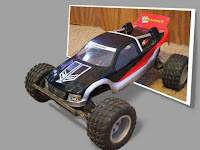
If you are a fan of DIY then Instructables is the place for you. They have thousands of tutorials. Everything from how to build a home made lava lamp to hand made alternatives to photo equipment. They also have some pretty cool Photoshop tutorials. This one shows you how to add a 3D effect to your images.

Creating a 3D effect with image editing software:

Here's how to make a neat effect to make it look like the subject of a photo is popping out of the background. This can be done with GIMP (GNU Image Manipulation Program) or Photoshop.

step 1 Get a good base photo
A good base photo will have a prominent subject with strong lines, strong perspective, and an uncluttered background. You should also use as high a resolution image as possible.

This image doesn't have super strong perspective, but if you look at my other images, you'll see that an image with strong perspective works best.

Friday, May 11, 2007

Art for sale!

We have added another artist to our For Sale Gallery. Ray Lusson is an Arizona native who decided to flee the heat of the desert for cooler climates. (Since it was 102 here yesterday, I can't say I blame him.) He now runs his own gallery in Depoe Bay, Oregon. One of Ray's reoccurring themes is something we don't see a lot of here in the desert; water. His tag line says it all: “Arizona Desert Rat Gone Coastal and Has the Photos to Prove It.”

To see Ray's work visit his gallery.

Wednesday, May 09, 2007

First Trillion-Pixel Image

This is some pretty amazing technology. I bet this image has enough information to wallpaper your house. Hope you like pink.
First 1 trillion-pixel image; by Donald Bell for CNET

Medical imaging specialists Aperio have broken the 4GB file size limit on the TIFF image format by creating their own format called BigTIFF and offering the format into the public domain (an amazing fact in its own right). To showcase the power of BigTIFF image resolution, Aperio has released the first terapixel image. The image shows 225 pathology slides of breast tissue and can be viewed and explored online (it looks surprisingly like a pink version of Google Earth once you start zooming in).

The image's actual file size as a compressed BigTIFF is 143GB, so don't expect to be shooting terapixel photos on your digital camera anytime soon. To make this kind of resolution useful, Aperio had to use a high-power oil immersion ScanScope slide-scanning system to get the necessary detail.

(via Medgadget)

Tuesday, May 08, 2007

Art Appreciation

More specifically photography. It is good to see that photography has been getting more attention lately in Phoenix. Richard Nilsen wrote a multi-part piece for the Arizona Republic in conjunction with the opening of Latent Image, a show starting this Friday running through August at the Mesa Art Center. It is really a fascinating article that covers many aspects of the industry from its beginnings, the key players, to what technology has added to the art form . Although there is too much information to post here, it is worth investing the time to read it for yourself. Here is a teaser...
Art that Clicks; Richard Nilsen for the Arizona Republic

The best photographs do the same thing as the best paintings or sculptures: They vivify our sense of being alive and bring us into contact with the world we often pay too little attention to. They act as caffeine for our senses, our thought and our emotions.

That's more than a snapshot attempts.

"What is the difference? Why are my snapshots not art?" asks Douglas Nickel, director of the Center for Creative Photography in Tucson, one of the world's best institutions for the collection and study of photographs.

On the gallery wall, you see a landscape by Ansel Adams or a still life by Edward Weston or a portrait by Richard Avedon. They carry something beyond the charge that wallet photos of your family has.

"Sometimes someone can come up with a really great picture," Nickel said of the amateur, "but their meanings are private - they mean something to them and the people around them. Art photography is meant as public statement. Art has a public function. It is meant to make a more universal statement about the condition of the world."

Like all art.

Because of photography's popular image, the gallery and museum world was slow in accepting it as art. Most museums didn't include photography in their exhibition schedules until a century after its invention, and color photography had to wait until the 1980s to be taken seriously.

When photographer Alfred Stieglitz tried to interest the nation's museums in photography in the early years of the past century, he initially got no takers.

"Photography can't be an art," he was told over and over, "because it's made by a machine."

Odd. You could say the same thing about a piano.

Finally, in 1924, the Boston Museum of Fine Art accepted Stieglitz's collection - grudgingly.

Times have changed: In 2005, a single photograph made by Stieglitz sold at auction for $1.4 million.